Choosing the best China door supplier requires more than comparing catalogue prices. It demands evidence, practical judgment, and careful questions. Doors may look similar online, yet their steel thickness, core density, coating quality, and hardware can differ significantly.
Industry data provides useful direction. The World Bank’s 2023 Logistics Performance Index gave China a score of 3.7 out of 5, ranking it 19th worldwide. This supports China’s strong manufacturing and export infrastructure, but logistics performance does not guarantee product quality. The International Trade Centre’s Trade Map, using UN Comtrade data, identifies China as a major exporter under HS codes 730830 and 441820, covering metal and wooden doors. These classifications show export scale, not dependable workmanship. That distinction matters.
A reliable door supplier should provide technical drawings, material specifications, test documents, and traceable production records. Ask for photos from welding, sanding, powder coating, and final inspection. Better still, request a sample door before approving bulk production. ISO 9001 certification can indicate structured quality management, but it should not replace factory verification. I have seen polished websites hide weak packaging and inconsistent dimensions. A checklist helps, though it is never perfect. Buyers should compare warranty terms, replacement procedures, moisture resistance, fire-rating evidence, and communication speed. The best choice is not always the cheapest factory. It is the supplier that can repeatedly meet your specifications, protect the shipment, and explain problems honestly. That takes time, but one careful audit can prevent hundreds of defective doors.
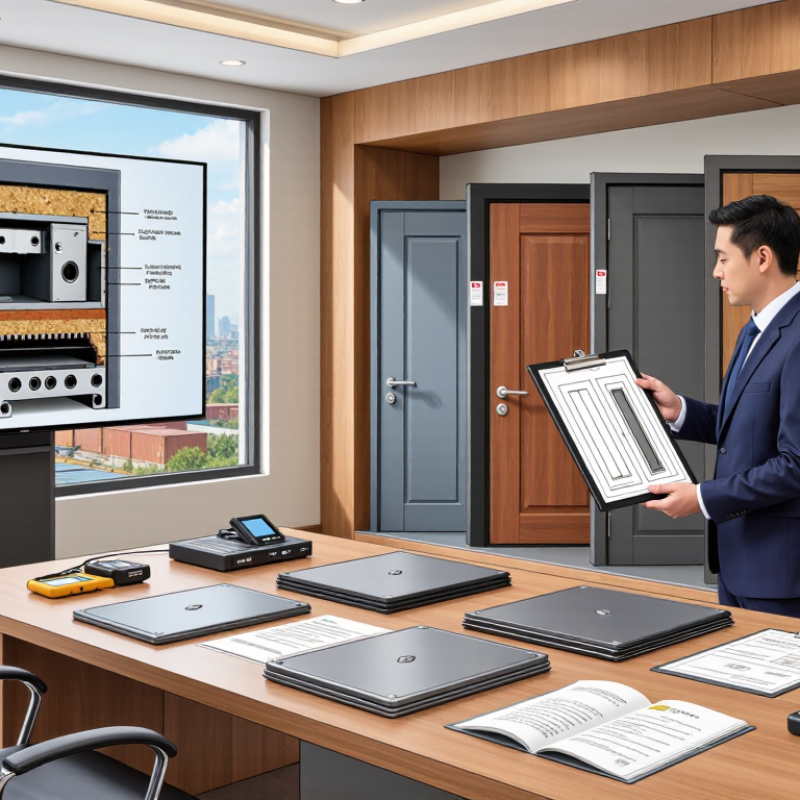
Finding the best China door supplier starts with a clear project brief. Measure every opening, including width, height, wall thickness, and floor level. Record the building type, climate, traffic volume, and expected service life. A hotel corridor needs different doors from a warehouse entrance. Small details matter.
Define the door material, core, surface finish, hardware, and color before requesting quotations. Specify fire resistance, acoustic performance, thermal insulation, water resistance, and security requirements. Confirm which local building codes and testing standards apply to your project. Ask suppliers for test reports, drawings, material samples, and installation instructions. Check whether the reports match the proposed door model, not a similar product. This step often reveals gaps.
I have seen projects delayed because hinge positions were never approved. Do not repeat that mistake. Create a schedule showing door numbers, sizes, swings, hardware, and room locations. Include acceptable tolerances and packaging expectations. Request a sample or prototype before mass production. Inspect its edge sealing, frame alignment, finish consistency, and closing action. Keep written records of every approval.
Your requirements should also include delivery dates, replacement procedures, inspection stages, and payment conditions. A low quotation can hide weak hardware or unclear testing responsibility. Compare suppliers against the same specification. Leave room for revision. Real projects change, and my own early specifications have sometimes been too optimistic about site conditions. Honest review protects both quality and budget.
| Requirement Area | Information to Define | Practical Project Standard | Documents or Evidence to Request | Priority |
|---|---|---|---|---|
| Building Application | Residential, hotel, office, hospital, school, industrial or commercial use | The door specification should match the building’s occupancy, traffic level, security needs and local construction regulations. | Floor plans, door schedules, room functions and applicable building-code references | Essential |
| Door Type | Single, double, sliding, folding, pivot, hinged or automatic door | Select the operating system according to available clearance, traffic frequency, accessibility requirements and maintenance conditions. | Door elevation drawings, opening details and operating diagrams | Essential |
| Opening Dimensions | Clear width, clear height, wall thickness, frame depth and threshold conditions | Specify finished opening dimensions and allowable tolerances; do not rely only on nominal door-leaf size. | Dimensioned site survey, approved shop drawings and installation drawings | Essential |
| Material and Finish | Steel, stainless steel, aluminum, timber, glass or composite construction | Define material grade, panel construction, surface finish, color reference, corrosion resistance and cleaning requirements. | Material certificates, finish samples, coating specifications and color samples | Essential |
| Fire Performance | Required fire-resistance period and smoke-control performance | Use the fire rating required by the project authority; common rated door classifications include 30, 60, 90 and 120 minutes, subject to local testing rules. | Valid fire-test reports, certification, product scope and approved hardware list | Essential |
| Acoustic Performance | Required sound reduction for bedrooms, meeting rooms, studios or healthcare areas | Specify the required laboratory or field acoustic rating and ensure the frame, seals, glazing and threshold are tested as a complete assembly. | Acoustic test report, door-set construction details and seal specifications | High |
| Thermal Performance | Climate zone, indoor temperature, energy target and exposure to weather | Define the target U-value or thermal transmittance requirement where energy regulations apply; include insulated panels and weather seals where necessary. | Thermal calculations, U-value data, gasket details and weather-performance test results | High |
| Security Level | Required resistance to forced entry, impact or unauthorized access | Define the threat level, lock type, cylinder format, hinge protection, frame anchoring and access-control interface before quotation. | Security classification, lock data sheets, hardware schedule and test documentation | Essential |
| Hardware and Access Control | Locks, closers, hinges, panic devices, readers, sensors and door operators | Confirm compatibility, power supply, fail-safe or fail-secure behavior, emergency release and coordination with the building control system. | Complete hardware schedule, wiring diagram, interface requirements and installation manual | Essential |
| Accessibility | Clear passage, opening force, thresholds, vision panels and control height | Follow the accessibility requirements applicable to the destination market and building type; verify clear opening after hardware installation. | Accessibility checklist, approved elevations and opening-force or clearance test results | Essential |
| Environmental Exposure | Humidity, rain, salt air, dust, chemicals, UV exposure and temperature range | Specify corrosion protection, drainage, seal design and suitable material selection for coastal, wet or industrial environments. | Corrosion-resistance data, coating system, environmental test results and maintenance instructions | High |
| Usage Frequency | Estimated daily cycles and peak traffic periods | Choose hardware and operators tested for the expected duty cycle; high-traffic entrances require stronger components and simpler maintenance access. | Cycle-test results, duty-cycle rating, maintenance schedule and spare-parts list | High |
| Quality Control | Inspection stages, dimensional accuracy, finish consistency and functional testing | Require documented inspections for incoming materials, production, assembly, operation and final packing before shipment. | Inspection and test plan, quality records, approved samples and pre-shipment inspection report | Essential |
| Packaging and Logistics | Shipment quantity, container planning, delivery location and installation sequence | Protect corners, glass, hardware and finished surfaces; label every package by opening number and installation area. | Packing specification, loading plan, carton labels, export documents and delivery schedule | High |
| Installation and After-Sales | Installer responsibility, site support, warranty, training and replacement parts | Define response times, warranty coverage, spare-parts availability, remote support and responsibility for installation defects. | Installation manual, warranty terms, service procedure, training plan and spare-parts catalog | High |
| Commercial Evaluation | Unit price, tooling, packaging, freight, duties, installation and lifecycle cost | Compare equivalent specifications and total delivered cost rather than comparing unit prices alone. | Itemized quotation, payment terms, lead time, Incoterms, exclusions and change-order policy | High |